Tuesday, February 17, 2009

Typealyzer


Typealyzer is a fun site where you can have the writing on your blog analysed!


It also shows you what parts of the brain were dominant during the writing.


Children would have a lot of fun having a look at this. I tried how it would work by using a class blog - it would be a lot of fun for children. I wonder if it would change during the year, for example when the teacher originally set up the site and then as children added to it.

Sunday, February 15, 2009

Science education


To help teachers develop their science programmes go to Science Learning.

This site has been set up by colleagues from Canterbury University, University of Waikato and the University of Auckland.

It is aimed to be used with Years 5-10 but there is a lot here that could be used with different levels. There are video clips of various scientists, demonstrations, animations as well as up-to-date information and data.

How wonderful is this, having so many resources to help in our classrooms?

Monday, February 9, 2009

LEARNZ - Virtual field trips


LEARNZ is a educational site for NZ teachers which offers virtual field trips for your class.

I know that many use these experiences regularly but did you know that this year it is free to register your class!
There are 22 trips planned for this year including CSO Making Music and Cool Wind Farm to Antarctica. These experiences are interactive and have a live component where they build relationships with the teachers and students.
There is a video you may like to look at which tells you about the LEARNZ tours.

"LEARNZ offers 20 virtual field trip experiences in 2008 and 20 in 2009: students stay at school but visit places they would never otherwise go to and interact with people they would never meet. Students' participation is supported by online background materials and activities, and is enabled using live audioconferencing, web board and diaries, images and videos uploaded daily.
New for 2009. All New Zealand Registered and Provisionally-Registered teachers are eligible to register free for 2009 (register once - no annual renewal required). Available Now: Teachers, once you have activated your registration, you have full access for 2009 to all field trips for your personal use. You also have access to a personalised control panel called MyLEARNZ (make sure you register first) where you can create a login for your classes and enrol them in 2000-2009 field trips, plus much more!

"

I would be interested in hearing about teachers experiences with LEARNZ as well as hearing from teachers in other countries about Virtual Field trips they are using.

Wednesday, February 4, 2009

Almanac for Virtual Worlds


FAS (The Federation of American Scientists) has a Virtual Worlds Almanac wiki for people to use. Teachers and students can to here to find information about many virtual worlds.


"We hope this will make it easier for the community to collaborate and to keep abreast of innovations and new product offerings," said FAS President Henry Kelly in a press release. "FAS is interested in the potential virtual worlds offer for education and learning."


I would be interested in hearing from teachers who are using virtual worlds, such as Second Life, in their teaching contacting me.

Monday, January 26, 2009

TPCK


During the summer holidays I have been reading The Handbook of Technological Pedagogical Content Knowledge (TPCK) for Educators, Edited by The AACTE Committee on Innovation and Technology.


If you have not read it here is a brief summary.
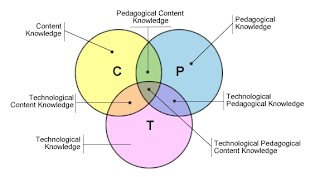
It looks at the concept and implementation of technological pedagogical content knowledge which is the knowledge and skills teachers need when they integrate technology into their classrooms in meaningful ways. Above left is a graphic to show the the TPCK framework - the complex interplay of three primary forms of knowledge: CK (content knowledge), PK (pedagogical knowledge) and TK (technogical knowledge).

Thursday, January 15, 2009

Science web site


Have just been reading an ESchool Newsletter about a science web site for schools.


The Siemens Foundation and Discovery Education have unveiled their new web site aiming to engage students in science education. They provide videos and hands-on activities for earth, life, and physical science to help educators turn their students into aspiring scientists.
I have been looking around the site and it is great. Teachers will find many ideas for their classrooms in here.
You need to sign up to enable you to down videos for example. They obviously think that only people from the USA are going to sign up as you need to give data about your school and give the State you reside in but just ignore those bits and the sign up goes through OK.

Tuesday, January 13, 2009

Referencing


A student of mine sent me a link to BibMe an easy way to store a bibliography list.

I have tried it out and found it really useful. You can quickly put in the information about your source and it will save in APA, MLA etc. A useful web site for teachers and students alike. I still like the Citation Machine as well but the beauty of this one is it will save the list for you and then you can download it when you are ready. It downloads as an RTF file to Word or another word processing programme.

Tuesday, December 16, 2008

Sqirlz

I am not sure if many people use Sqirlz to animate water reflections from a still image. Here is a great example.


It is a simple programme to use in the classroom. Once the reflection is complete you have the options of saving as a gif, swf or avi.


I have used this programme for some time now and find it great to create water effects. The completed files can be used in PowerPoint, web pages for example.


I have often used this with my students when they are making a multimedia presentation as it is so quick and easy.

Sunday, December 14, 2008

100 useful web tools for education


A great place to find different web tools to use for all the different styles of learning. Christina Laun has written this to enable teachers to find tools that are best suited to different learners. You will find tools for mind mapping, charting and diagrams, video and photos, podcasts, presentation tools, audio tools, text readers, audio books, note taking tools, bookmarking, interaction and collaboration.

Monday, December 1, 2008

Studies Show Deep Understanding Derives from Collaborative Methods

I have been reading an interesting article from the Edutopia magazine about how deep understanding derives from collaborative methods.

This is very interesting for all teachers to read is the research to show how cooperative learning and inquiry-based teaching can have big dividends in the classroom.

"Evidence shows that inquiry-based, collaborative approaches benefit
students in learning important twenty-first-century skills, such as the ability
to work in teams, solve complex problems, and apply knowledge from one lesson to
others. The research suggests that inquiry-based lessons and meaningful group
work can be challenging to implement. They require changes in curriculum,
instruction, and assessment practices -- changes that are often new for teachers
and students.
Teachers need time and a community to organize sustained
project work. Inquiry-based instruction can help teachers deepen their
repertoire for connecting with their peers and students in new and meaningful
ways. That's powerful teaching and learning -- for students and teachers
alike
."